GLP-1 medications help many people lose significant weight. But a growing number of people are also noticing something unexpected once the weight comes off. Here’s what’s going on with your skin — and what you can do about it.
What happens to your skin during Ozempic weight loss?
If you’ve been on Ozempic, Wegovy or Mounjaro — or you know someone who has — you may have noticed something that doesn’t quite match the result on the scale. The weight is down. But the skin doesn’t follow at the same pace. It feels looser. Less firm. Sometimes older-looking than expected.
More and more people are talking about this — doctors are writing about it, and people who’ve experienced it are sharing their stories widely. And yet most people only encounter this information after they’ve already noticed the changes. The aim of this article is to help you understand what’s happening, whether you’re just starting out, already in treatment, or looking for solutions to changes you’re seeing now.
Your body loses fat fast. Your skin doesn’t have enough time to adapt.
Losing weight at speed — which GLP-1 medications are designed to do — means the skin above the areas of fat loss loses its underlying support faster than it can adjust. The skin needs time to contract and restructure. When fat disappears in months rather than years, that time simply isn’t there.
These medications are genuinely effective. In one of the largest clinical trials of these drugs, participants lost close to 15% of their body weight over 68 weeks on average — significantly faster than diet and exercise alone typically achieve.
Reference: Wilding et al., STEP 1 trial, NEJM 2021. Full citation in sources.
The drug itself affects your collagen.
Here’s the part that surprises most people. Research published in 2025 shows that GLP-1 drugs — the class of medication that includes Ozempic, Wegovy and Mounjaro — don’t just cause fat loss faster than skin can respond. They also directly affect the cells that produce collagen and elastin.
These cells, which live in the fatty layer of tissue just beneath the skin, actually have receptors for GLP-1 on their surface. When the drug activates those receptors, it reduces the cells’ ability to produce collagen, elastin and hyaluronic acid — the proteins that keep skin firm, elastic and structured.
References: ‘GLP-1RA and the possible skin aging’, PMC12370548 (2025); Fabi, S., Healio Dermatology, August 2025.
Biopsies of patients on GLP-1 treatment have confirmed structural changes in the skin’s middle layer — including reduced density of both collagen and elastic fibres.
Reference: PMC12110338.
So the skin is managing two things at once: losing volume faster than it can keep up with, while also having a reduced capacity to produce the structure that would help it recover.
It’s not just the skin. Muscle tone changes too.
From the age of 40, the body’s natural production of collagen already begins to slow. This is why the effects of rapid weight loss tend to show up more visibly in this age group — the skin has less resilience to draw on to begin with. Combine that with the reduction in muscle support that comes with significant weight loss, and the changes become more noticeable.
Muscle sits underneath the skin and gives it shape and support. Clinical data shows that lean tissue — not just fat — is reduced during GLP-1 treatment. When that underlying structure becomes less defined, the skin above it has less to hold onto, particularly in areas like the abdomen, arms and thighs.
Reference: STEP 1 body composition substudy, PMC8089287. Full citation in sources.
Who tends to notice this more?
Not everyone using GLP-1 medications will see the same changes. A few factors make a meaningful difference:
Age. From around 40, collagen production is already declining naturally. When GLP-1 treatment further slows the cells that produce it, the effect is more visible.
Speed of weight loss. Losing more than 10% of body weight in 3 to 4 months gives skin less time to catch up.
Skin health at the start of treatment. Sun exposure history, genetics and lifestyle factors all affect how elastic skin is before treatment begins.
Protein intake during Ozempic, Wegovy or Mounjaro treatment. Low protein worsens lean mass loss and slows tissue recovery.
The term ‘Ozempic face’ — the hollowed-out, older-looking appearance around the cheeks, temples and jaw — has been documented in peer-reviewed dermatology literature and is widely discussed by doctors and patients alike. The same pattern appears across the body: looser skin on the arms, abdomen and thighs is increasingly reported by people who have completed GLP-1 treatment. There are effective ways to address these changes — and the right moment to start is earlier than most people think.
References: Defiance-health.com; eurekahealth.com, October 2025; PMC12232544.
What helps — and how it works
The skin’s response to rapid weight loss is a biological process, and it can be supported. The most effective non-invasive approaches work by encouraging the body to produce new collagen from within, and by maintaining the muscle tone that gives skin its underlying structure. Below is how each technology works — and why the combination matters.
Radiofrequency — encouraging the skin to rebuild its collagen
Radiofrequency treatment uses controlled thermal energy to reach the deeper layers of the skin. The heat works in two ways: it contracts existing collagen fibres, producing an immediate tightening effect, and it signals the body to produce new collagen — a process called neocollagenesis.
References: PMC4631236; ‘Radiofrequency in Facial Rejuvenation’, IJDV 2022.
A 2025 study found that radiofrequency treatment produced measurable improvements in collagen and elastic fibre density, confirmed by tissue analysis. More than half of patients reported over 50% improvement in skin firmness at two months, with no serious adverse effects.
Reference: PMC12475914, 2025.
In a study specifically on loose skin after weight loss, radiofrequency treatment produced a 5-point improvement on a validated clinical scale after just two sessions.
Reference: PMC6624002, Journal of Clinical and Aesthetic Dermatology.
Neurostimulation — keeping the muscles active
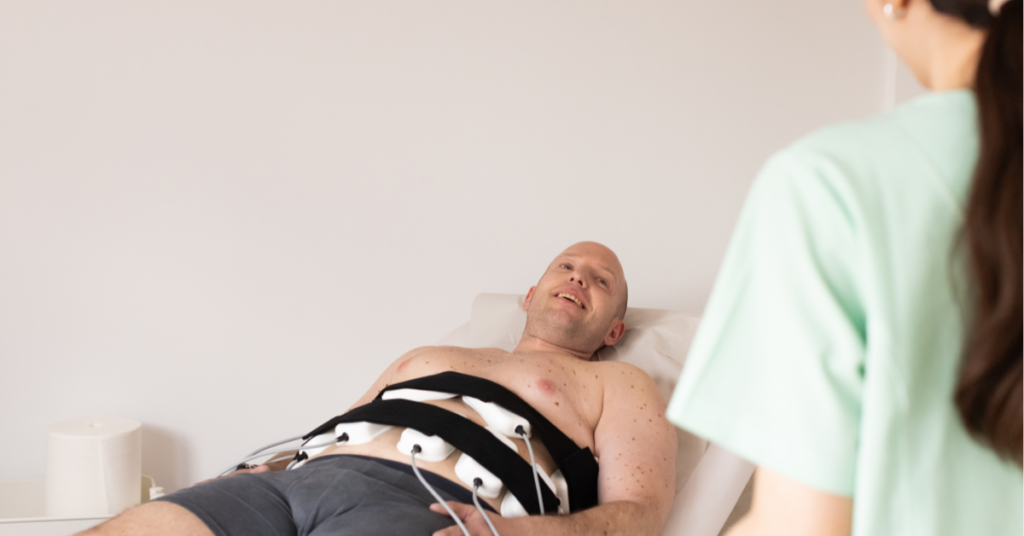
Because loose skin is partly caused by the reduction in muscle tone underneath, neurostimulation plays an important role alongside skin treatment. It uses controlled electrical impulses to reactivate and maintain muscle in the areas where weight loss has reduced the structural support — abdomen, glutes, inner arms and thighs.
Bioactive Therapy — feeding the tissue
Rapid weight loss also affects the skin’s hydration and overall quality. Bioactive Therapy uses a transdermal delivery method to introduce active ingredients into the tissue — without needles — supporting skin quality and cellular renewal at a level that topical products alone cannot reach.
Can you prevent loose skin while you’re still on the medication?
Yes. Most people don’t start thinking about their skin until treatment is over. By then, some of the changes are already established. Starting a collagen-stimulating programme while you’re still actively losing weight gives the skin support as it changes — rather than asking it to recover the ground it’s already lost.
The skin is adapting in real time. Giving it support in real time — during treatment rather than after — makes a significant difference to the outcome.
The WHO published its first official guidance on GLP-1 therapy in 2025, noting that these medications work best as part of a broader approach that includes physical support. Skin and tissue care is part of that picture.
Reference: WHO 2025 Guidelines on GLP-1 and Obesity.
Where can you get treatment — and what does it involve?
Most clinics address these concerns one at a time — a separate appointment for skin tightening, another for muscle tone, another for tissue quality. Reductiva combines all three in a single 45-minute session: radiofrequency, neurostimulation and bioactive therapy working together, on the same day, in the same room. It’s not just more convenient — it’s more effective, because the three technologies address different layers of the same problem simultaneously.
Every course at Reductiva begins with a personalised assessment. A specialist looks at the specific areas you want to address, where you are in your GLP-1 journey, and what results you’re aiming for. The protocol is built around that — not a standard package applied to everyone.
No surgery. No needles. No recovery time.
Reductiva has two clinics in Barcelona — Paseo de Gracia and Muntaner — and a clinic in Angers, France.